
Reverse Charge Mechanism
"Reverse Charge is a mechanism where the recipient of the goods and/or services is liable to pay GST instead of the supplier."
When is Reverse Charge Applicable?
A. Supply from an Unregistered dealer to a Registered dealer
If a vendor who is not registered under GST supplies goods to a person registered under GST, then Reverse Charge will apply. This means that GST must be paid directly by the receiver to the Government instead of the supplier.
The registered dealer who pays GST under reverse charge has to do self-invoicing for the purchases made. For inter-state purchases, the buyer has to pay IGST. For intra-state purchases, CGST and SGST have to be paid under RCM by the purchaser.
B. Services through an e-commerce operator
If an e-commerce operator supplies services, then reverse charge will be applicable to the e-commerce operator. He will be liable to pay GST.
For example, UrbanClap provides services of plumbers, electricians, teachers, beauticians, etc. UrbanClap is liable to pay GST and collect it from the customers instead of the registered service providers.
If the e-commerce operator does not have a physical presence in the taxable territory, then a person representing such electronic commerce operator for any purpose will be liable to pay tax. If there is no representative, the operator will appoint a representative who will be held liable to pay GST.
Compliances in respect of supplies under reverse charge mechanism
As per section 31 of the CGST Act, 2017, read with Rule 46 of the CGST Rules, 2017, every tax invoice has to mention whether the tax in respect of supply in the invoice is payable on reverse charge. Similarly, this also needs to be mentioned in receipt vouchers as well as refund vouchers, if tax is payable on reverse charge.
Maintenance of accounts by registered persons: Every registered person is required to keep and maintain records of all supplies attracting payment of tax on reverse charge.
Any amount payable under reverse charge shall be paid by debiting the electronic cash ledger. In other words, reverse charge liability cannot be discharged by using input tax credit. However, after discharging reverse charge liability, credit of the same can be taken by the recipient, if he is otherwise eligible.
Invoice-level information in respect of all supplies attracting reverse charge, rate-wise, is to be furnished separately in table 4B of GSTR-1.
Advance paid for reverse charge supplies is also leviable to GST. The person making advance payment has to pay tax on reverse charge basis.
What is Reverse Charge in GST?
It is a new concept introduced in GST in India to increase tax revenues, coverage, and compliance from partly or unorganized sectors.
Earlier, goods were exempt from this scheme; now the collection of GST will increase tremendously.
In GST, the supplier is liable to collect tax on goods and services provided. But the central government has the power to notify categories of supplies against which the service recipient has to discharge the tax liability. Hence, all the provisions of the Act will now be applicable to the recipient of such goods or services as if he is the supplier.
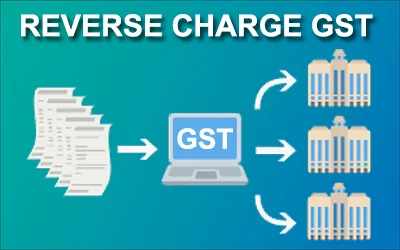
When a person becomes liable to pay tax on the reverse charge, certain provisions like threshold exemption, time of supply, availing of input credit changes. There is a threshold limit for turnover aggregating to Rs.20 Lakhs for registration for normal tax payers but under reverse charge, there is no such limit. The person has to be registered under GST irrespective of the aggregate limit.
How Can You Comply Better With GST
Even if you have a CA to look after your financial accounting, it’s advisable to implement good GST-compliant accounting software which simplifies the whole process.
ProfitBooks is one such accounting software which not only helps you create GST invoices, track purchases, and manage inventory but also helps you file GST returns online with just a few clicks. It’s trusted by thousands of businesses and CAs across India. It takes just 2 minutes to sign up.